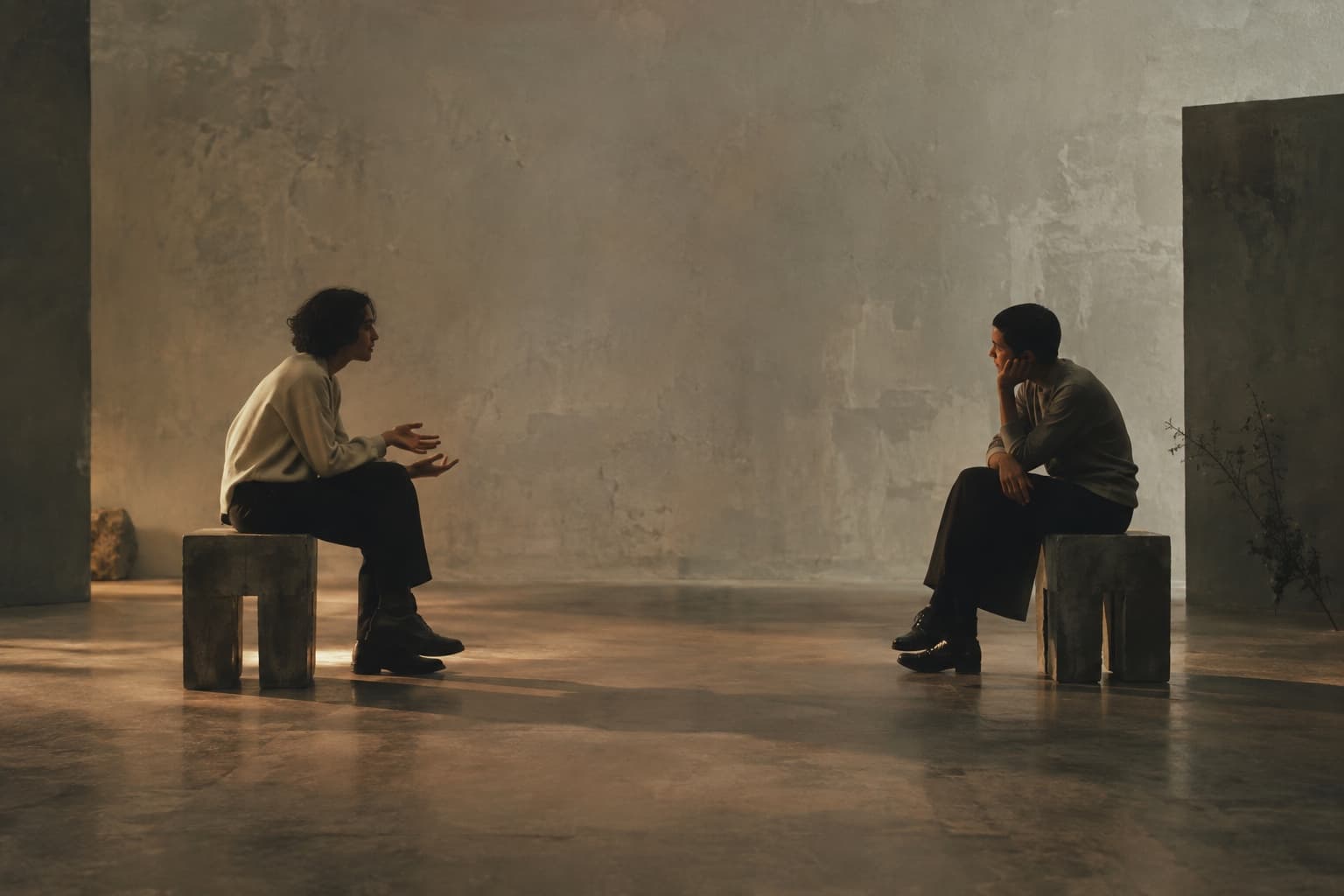
A few weeks ago, I made a video asking men a very simple question:
How are you?
That was genuinely it.
I wasn't conducting research or trying to uncover anything particularly serious. I thought the comment section would be quite cheerful. Someone might say they had had a stressful day at work, someone else would say they were fine, and perhaps men would talk amongst themselves.
Instead, I received more than 200 comments, and the conversation was very different from what I had expected.
There was a lot of hurt. Some men said they had nobody they could confidently talk to. Others said they would rather keep whatever they were going through to themselves because they did not want to appear weak. There were men who would tell me they were fine and then, in the same comment, explain something that made it quite obvious that they were not.
It made me look more closely at myself and the people around me. I have always thought that I give people room to be vulnerable with me, not specifically men, just people. But those comments made me wonder how many people are walking around carrying things they have never properly spoken about.
Where does everything we don't say go?
People often say that hurt people hurt people. I don't think that should be taken to mean that everybody who has experienced hurt will inevitably hurt someone else. I have been hurt many times myself, and one thing I have had to become conscious of is reminding myself:
The new person didn't hurt me.
That doesn't mean becoming naïve. I can get to know somebody for who they are while still being careful enough to recognise patterns I have seen before.
I have also experienced what happens when someone cannot make that distinction. I have been with someone who carried previous experiences into our relationship. I was constantly doubted. I wasn't taken seriously. I didn't feel loved in the way I should have been. I became the person dealing with the consequences of things I had not done.
The easiest way I can explain it is probably with a dog.
Imagine having a dog you absolutely love. You feed it, take it for walks, play with it, take pictures and build memories with it. Eventually, the dog dies and you are devastated.
Later, you get another dog.
This time, you decide you aren't going to become so attached. You feed it and make sure it is fine, but perhaps you don't play with it as much. You don't take it everywhere. You don't take all the pictures. You deliberately avoid creating too many memories because you don't want to experience that kind of loss again.
Except the new dog didn't cause the first dog's death.
Human relationships are obviously more complicated than that, but this is the closest analogy I have for what I mean. Sometimes unaddressed hurt finds somewhere else to go.
I am careful, however, about using that idea to explain people's behaviour from the outside. For some people, what they are doing may be conscious. For others, it may be subconscious. My background is in Guidance and Counselling, and one thing studying counselling theories taught me was to look beyond an action or statement and ask what sits behind it.
You ask questions. You allow the person to talk.
Unless given the opportunity to speak to someone, I'm not at liberty to draw that conclusion.
Then it became a gender conversation
I knew when I made the video that it could send the wrong signal. The internet is already incredibly tense around gender roles, inequality, relationships and who is responsible for what.
Some women questioned why I was creating space for men. The sentiment was essentially: women should advocate for women and allow men to look after themselves.
I understand where some of that feeling comes from.
Women continue to experience serious gender-specific harms. In England and Wales, the Crime Survey estimated that 9.1% of women and 6.5% of men experienced domestic abuse in the year ending March 2025. Recognising that matters, and advocating for men's mental health does not require pretending otherwise.
But two things can be true.
Men are also experiencing problems that deserve attention. In 2024, the male suicide rate in England and Wales was 17.6 deaths per 100,000, compared with 5.7 for women. Research has also found that expectations around masculinity, including concerns about appearing weak, can affect men's willingness to seek psychological help.
Those statistics don't turn this into a competition over who suffers more. If anything, I think that is exactly the conversation I want to avoid.
So why, as a woman, am I talking about men's mental health?
Because I'm human.
My studies weren't limited to gender. Neither is my concern for people.
My gynaecologist is a man. My urologist is a man too. Imagine what healthcare would look like if every professional decided they would only concern themselves with people of their own gender.
Of course, gender-specific advocacy has its place. I am not asking women to stop advocating for women, nor am I asking women to take responsibility for fixing men.
What I am saying is much simpler. Men can advocate for men. Women can advocate for men. Men can advocate for women. Women can advocate for women.
We need to start looking out for each other.
Then I thought about the boy
Around the same time, I read about Robin Windsor, the former Strictly Come Dancing professional who died by suicide in 2024. At the subsequent inquest, his friend Lisa Riley said that Windsor had told her he had been sexually abused by an older dance tutor when he was younger and felt his parents had never fully understood what had happened to him.
The first person I thought about when I read that wasn't Robin Windsor the adult.
I thought about him as a boy.
I imagined having a male child and something like that happening to him. Then the questions started.
Who did he speak to?
What was he saying?
What did asking for help look like?
And why did he feel that people weren't understanding him?
One detail from the inquest stayed with me. Riley said that around Christmas 2023 she contacted Windsor after seeing what she considered a very dark Facebook post. His response was that he was "fine, just usual ups and downs of life."
There is that word again.
Fine.
I don't know Robin Windsor, and I don't want to retrospectively diagnose someone I never met or suggest that one conversation could have changed what eventually happened. His inquest considered several contributing circumstances, and suicide is far too complex to reduce to one childhood experience or one missed conversation.
What his story did make me question was something else: what are we teaching children before they become adults who struggle to talk?
What are we teaching the boy?
If I had a son, I would want him to receive some of the same education we increasingly understand is important for girls.
If somebody touches you inappropriately, say no. Scream. Leave. Tell somebody.
More importantly:
I love you regardless of what happens. Tell me anything.
I would want him to understand his body, his sexual organs and his hormones. I would want conversations about sex and consent to happen before something has already gone wrong.
I would also want him to understand rejection.
If a girl says no to him, I don't want him interpreting that as an attack on his masculinity. There will probably be people in life whom he really likes who simply don't like him back. There will also be people who really like him whom he isn't interested in.
And one day, hopefully, there will be someone he genuinely loves who genuinely loves him too.
He just has to be patient.
Even as his mother, there will be things he desperately wants that I will tell him no to, despite the fact that I would do almost anything for him. Being denied something doesn't mean you are unloved or unworthy. Sometimes it is simply somebody else's choice.
This is one reason I don't think protecting girls and educating boys should be competing ideas. We absolutely should teach girls how to recognise danger and protect themselves. But shouldn't we also be asking what we're teaching boys about how to exist around girls?
Be polite. Be respectful. Understand consent. Don't take a woman's no as aggression or as evidence that you are somehow less of a man. Understand the damage sexual violence does to another person.
And none of this is an excuse for harmful behaviour.
Understanding where behaviour may have come from is not the same as excusing it.
We all have choices. Experiencing pain does not give anybody permission to inflict pain on somebody else. I simply think there is value in asking what we can teach people before we reach the point where harm has already happened.
Maybe speaking isn't the part we're getting wrong
This is where my thoughts eventually moved beyond men altogether.
We have become very good at telling people to speak.
Speak up.
Tell someone.
Ask for help.
Check on your friends.
But after reading those comments, looking at my own experiences and paying closer attention to the people around me, I started wondering whether we're putting so much emphasis on the person who is struggling that we're forgetting about the person on the other side of the conversation.
What happens after somebody speaks?
Because listening starts at home, and often it doesn't look like a mental health conversation at all.
"I'm tired."
"We're all tired."
Conversation over.
"I had a bad day at work."
"Don't we all?"
Conversation over.
Or a child comes home and says:
"Mum, I don't want to go to this school anymore."
"That's where all the bright children go."
Again, conversation over.
Maybe the child simply doesn't like the school anymore. Maybe there is a teacher they don't get along with. Maybe they're struggling academically. Maybe somebody is bullying them.
We don't know.
And that's precisely the point.
What if we simply asked why?
"Mum, I don't want to go to this school anymore."
"Why?"
That one question gives the child somewhere to start.
Of course, the way we ask matters. We can ask why? with irritation, suspicion or judgement and receive completely different responses. I mean a concerned and genuine why. The kind that makes another person comfortable enough to walk you through their memory lanes and explain how they arrived at what they just said.
This is also why I don't think everybody who comes to us needs advice.
Sometimes people already know what they need to do. They're smart enough to make their own decisions. The situation has simply been weighing on them and they want somewhere to put that burden for a moment. In that situation, perhaps they just need you to listen.
Sometimes what they need is clarity. Their judgement may be clouded, they may have several possible paths in front of them, and talking allows them to see those choices differently. You can ask questions and help them interpret what they are looking at, but they still make the decision.
And sometimes listening isn't enough.
If someone tells me they are thinking about harming themselves or another person, for example, that has moved beyond helping them think through a problem. The same applies where somebody is experiencing abuse or there is an immediate concern for their safety. Those situations require appropriate professional or safeguarding support.
Being a confidant does not mean pretending to be qualified for something you're not.
This started with men. It isn't really about men.
Men made me notice something I hadn't paid enough attention to before, but this is ultimately about mental health awareness as a whole.
Women struggle. Men struggle. Children struggle. And people don't always announce that struggle in the language we expect them to use.
Sometimes it sounds like:
I'm tired.
I'm confused.
I don't want to go.
Leave me alone.
I'm fine.
Not every "I'm tired" means something is terribly wrong. Not every quiet person is experiencing a mental health crisis, and we shouldn't start diagnosing the people around us because their behaviour changes.
But perhaps we can become more curious about each other.
We spend a lot of time encouraging people to find the courage to speak. I think we should spend some time thinking about whether, when they finally do, we have created the kind of environment in which they would want to keep talking.
Sometimes that might begin with nothing more complicated than a genuine:
Why?
And then, instead of preparing the answer, giving advice or deciding what they mean, we listen.